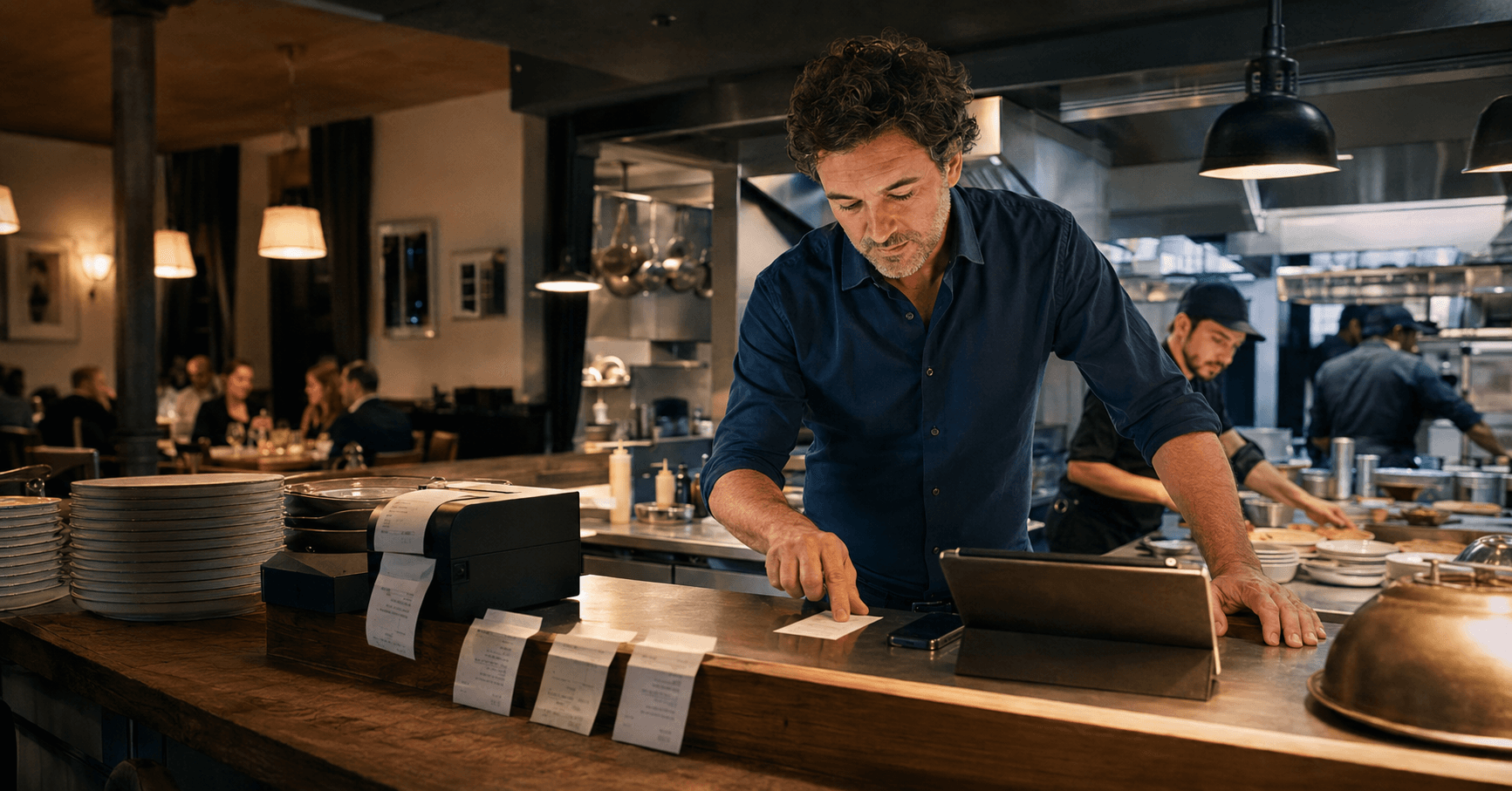
Conversations about restaurant digitalization often begin with a list.
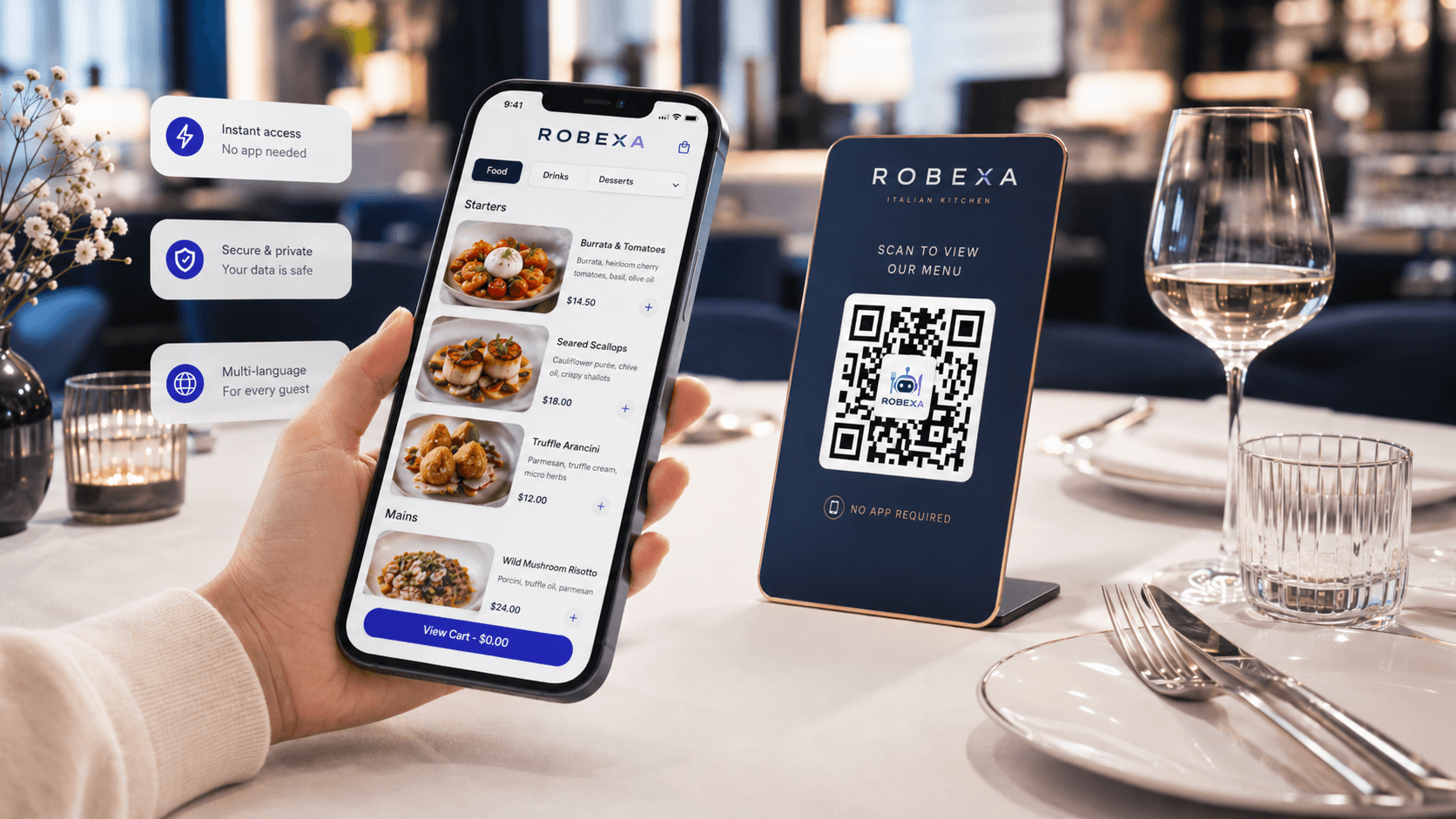
QR ordering. Kitchen display systems. Reservations. WhatsApp ordering. Vouchers. Reports.
The list can become long very quickly.
But restaurant operators do not buy a feature list. They invest in fewer repeated tasks, fewer mistakes and a smoother operation when everything happens at once on a busy Saturday evening.
Key takeaways
- Restaurant software is bought to solve operational bottlenecks, not to collect features.
- The biggest losses often sit between systems, not inside one tool.
- Clarify the bottleneck first, then choose the matching module.
- Success should be measurable: fewer handovers, fewer errors, clearer workflows.
That distinction matters.
Technology is only valuable when it improves what happens between the guest placing an order and the team preparing, serving and completing it.
The real problem often sits between systems
In many restaurants, the main difficulty is not one individual piece of software.
It is the gap between several tools and working methods.
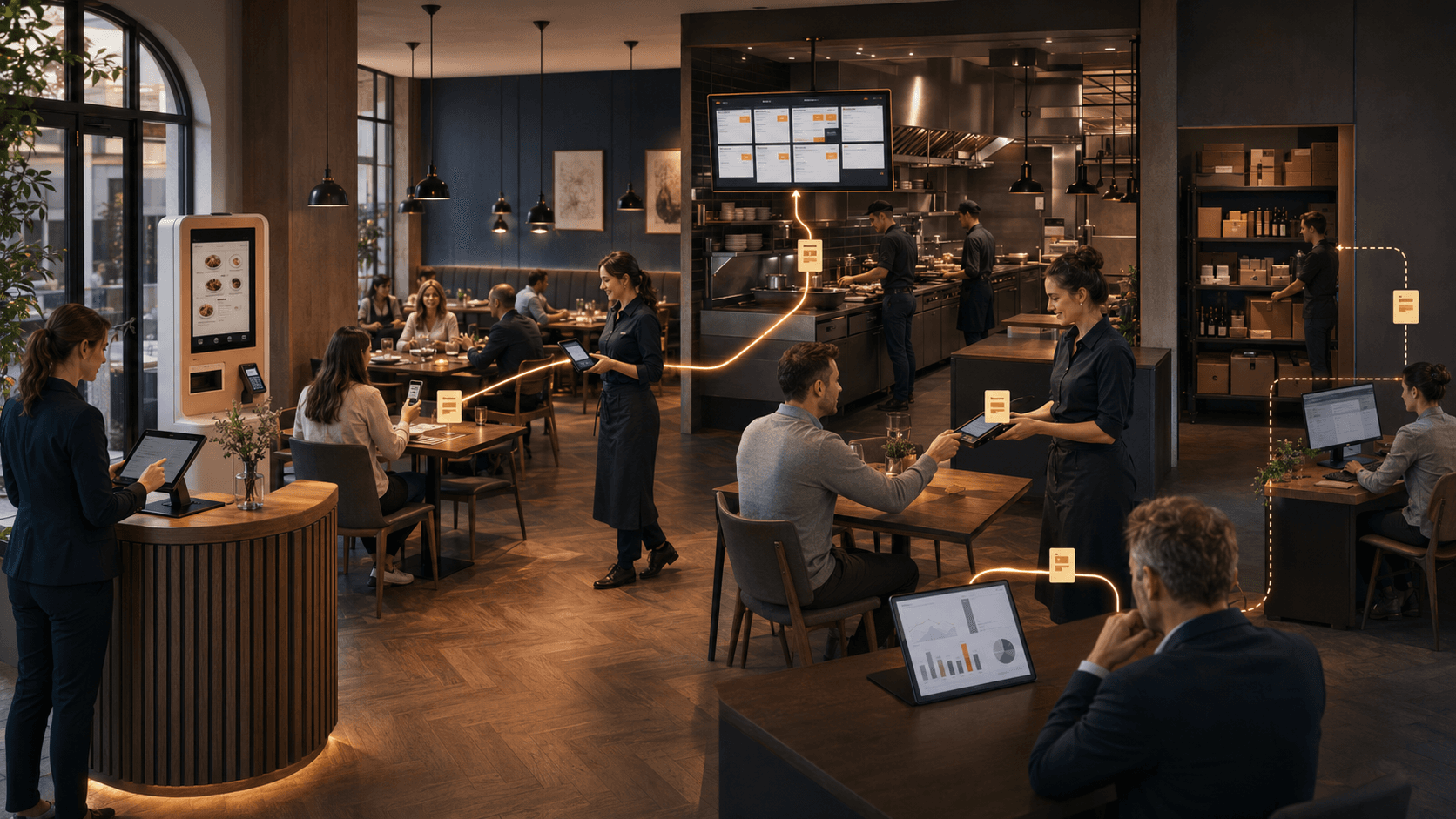
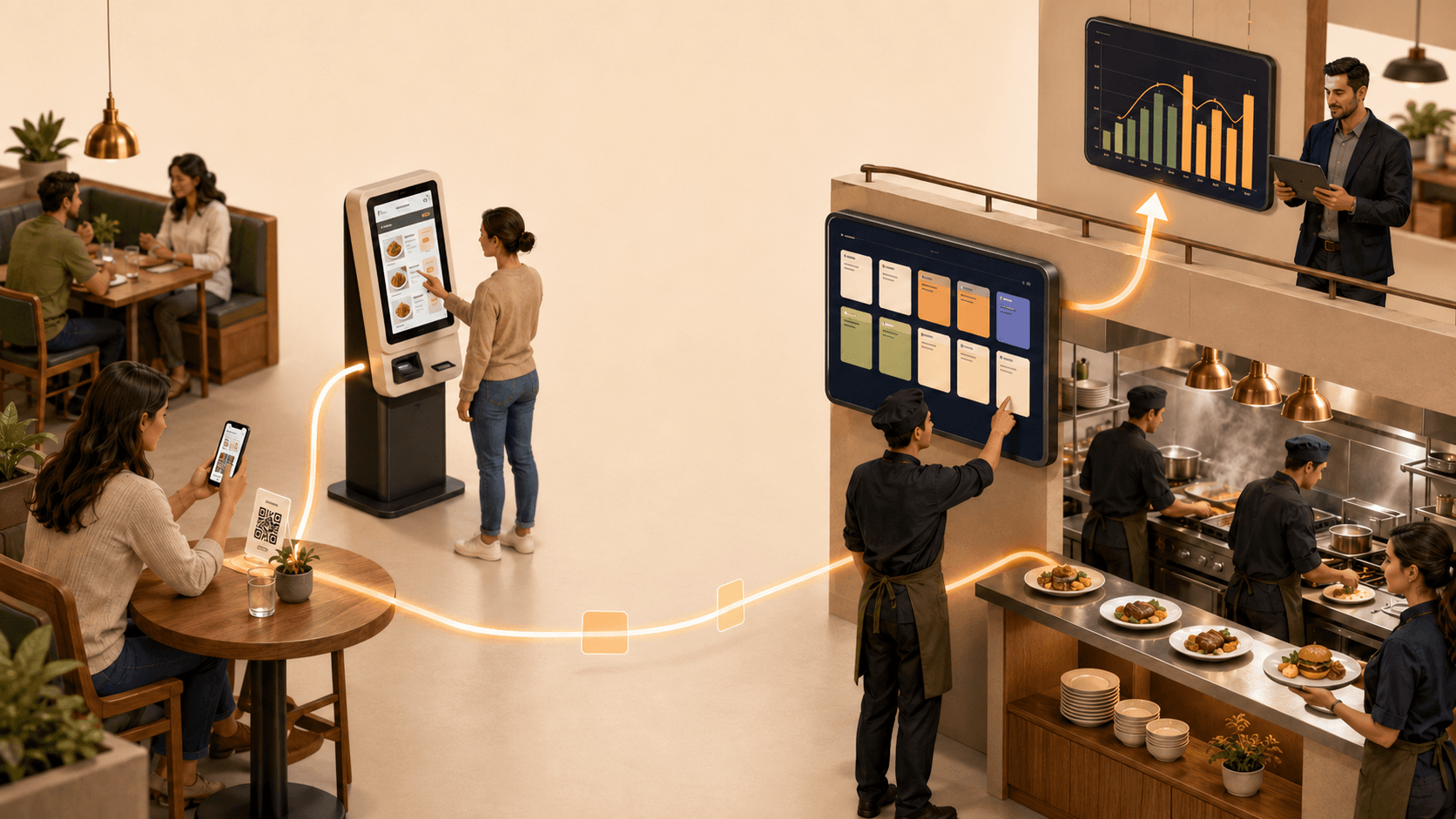
Orders may arrive by telephone, through the restaurant website, from delivery platforms or directly at the table. Employees copy information from one place to another. The kitchen asks for clarification. Tickets are missed. Guests wait.
Each unnecessary handover takes time.
Each manual transfer also creates another opportunity for information to be misunderstood, entered incorrectly or forgotten.
A restaurant may already use several digital tools and still depend heavily on handwritten notes, verbal explanations and repeated data entry.
That is why adding one more application does not automatically improve the operation.
Sometimes it simply creates one more screen that somebody needs to monitor.
Start with the bottleneck, not the product demo
Good restaurant digitalization should not begin with a presentation of every available module.
It should begin with a small number of practical questions:
- Where are orders entered more than once today?
- Which process breaks down first during peak hours?
- How often does that happen?
- What does the problem cost in time, mistakes or lost orders?
- What would need to improve within 60 days for the change to be considered successful?
These questions create a much clearer starting point than a catalogue of functions.
Only after the operational problem is understood does it make sense to discuss technology.
The right solution for one restaurant may be direct ordering through its own website. For another, the priority may be table ordering, kitchen coordination, service requests or a clearer reservation process.
Not every restaurant needs every module.
More software is not the goal
At Robexa, we follow a simple principle: identify one concrete bottleneck first, then connect the processes that are directly involved.
Depending on the restaurant, that may include direct orders through the web or WhatsApp, table orders, service workflows and kitchen operations.
The goal is not to make the restaurant feel more technical.
The goal is to create an operation in which:
- orders are entered fewer times,
- information is easier to find,
- responsibilities are clearer,
- fewer questions need to be repeated,
- and tasks move more reliably from one team to another.
A well-designed system should reduce complexity for the people using it.
It should not require employees to understand the technical architecture behind every action.
Restaurant teams experience problems as interruptions
Many operational problems appear small when viewed individually.
A server walks back to a table because an option was not recorded. A kitchen employee asks which side dish belongs to an order. A takeaway request is copied from WhatsApp into another system. A guest waits because the service team did not see a new request.
Each interruption may take only a minute.
But during a busy service, these minutes accumulate. They interrupt concentration, slow down preparation and create pressure across the team.
This is why workflow design matters more than the number of available features.
A connected process can prevent information from being repeatedly searched for, copied or explained.
The best solution depends on the restaurant
A small café, a delivery-focused kitchen, a full-service restaurant and a multi-location operation do not have the same priorities.
For one business, the largest problem may be telephone orders.
For another, it may be slow communication between the dining room and the kitchen.
A restaurant with a large terrace may need a better way to handle repeat drink orders. A multi-location business may be more concerned with consistent menus, reporting and central administration.
Digitalization works best when it reflects the actual operation.
That means observing how orders, information and responsibilities move through the restaurant before deciding which tools should be introduced.
Success should be measurable
A new system should not be considered successful simply because it has been installed.
The outcome must be visible in daily operations.
Useful indicators may include:
- fewer manual entries,
- fewer order corrections,
- shorter processing times,
- fewer clarification requests,
- a higher share of direct orders,
- and more time available for guest service.
The exact measurements will vary from one restaurant to another.
What matters is agreeing on them before implementation.
Without a clear definition of success, it becomes difficult to distinguish real improvement from the temporary excitement of introducing new technology.
Technology should support the team during pressure
Restaurant software proves its value during busy periods, not during a quiet demonstration.
On a full Saturday evening, employees should not need to stop and think about which system contains the right information.
The process should be clear enough that the next task, order status or responsibility can be understood immediately.
That does not mean every interaction needs to be automated.
Personal service, hospitality and human judgement remain essential.
Technology should take care of repetitive transfers and routine coordination so that the team can focus on guests, quality and exceptional situations.
Restaurant technology is good when it requires almost no explanation during a fully booked Saturday evening — and the team still feels the difference it makes.
The right question is not “Which features do you offer?”
Feature lists are useful later in the decision process.
They help compare systems and confirm technical requirements.
But they should not be the beginning of the conversation.
The better starting question is:
Which process currently costs your restaurant the most time, concentration or frustration?
Once that is clear, software can be evaluated against a real operational need.
That is how technology becomes more than a collection of functions.
It becomes a practical way to make everyday restaurant work clearer, calmer and more reliable.