A restaurant can be understaffed on Friday evening and still schedule too many paid hours on Monday afternoon. Both situations are expensive. Understaffing creates queues, mistakes and exhausted employees. Overstaffing consumes labor hours when very few orders are coming in.
That is the real staffing challenge facing restaurants today. It is not only a question of whether a business can find enough people. It is also a question of placing the available labor where guests, the kitchen and revenue genuinely require it.
Robexa connects two sides of that problem. Management can use orders and sales to see when the business is actually busy. At the same time, connected ordering and kitchen workflows reduce repetitive tasks — from capturing a standard order to manually carrying its information into the kitchen.
The goal is not a restaurant without people.
The goal is a restaurant where people spend less time walking unnecessarily, entering the same information twice and bridging gaps between disconnected systems.
Key takeaways
- In a DEHOGA member survey at the beginning of 2026, labor costs were the most frequently cited pressure on hospitality businesses.
- The German hospitality labor cost index in the fourth quarter of 2025 was 39.6 percent above the fourth quarter of 2019.
- In North Rhine-Westphalia, 58.8 percent of dependent employment relationships in food service were Minijobs in 2024.
- Hourly order and sales reporting helps operators identify recurring rush periods and consistently quiet windows.
- QR ordering, a kitchen display system and a self-ordering kiosk reduce different kinds of manual work; they are not interchangeable products.
- Savings should be measured in the restaurant itself through paid hours, sales, orders, ticket times and service quality rather than promised as a generic percentage.
Staffing pressure is a cost, capacity and workflow problem
The phrase “staff shortage” describes only part of the situation. Many restaurants still struggle to recruit for particular roles. At the same time, soft demand and rising costs mean operators cannot afford imprecise schedules.
In a DEHOGA member survey at the start of 2026, 75.2 percent of participating businesses named personnel costs as an urgent pressure — ahead of bureaucracy, energy, food and beverages. The latest available DEHOGA industry figures also show that the hospitality labor cost index was 39.6 percent higher in the fourth quarter of 2025 than in the fourth quarter of 2019.
At the same time, nominal revenue can give a misleading impression of recovery. According to Germany’s Federal Statistical Office, food-service sector revenue in May 2026 was 0.7 percent higher than a year earlier in nominal terms but 7.1 percent lower after adjusting for prices.
This creates a difficult operating equation:
- wages and total employer labor costs rise;
- guests remain price-sensitive;
- real sales volume stays under pressure;
- too few people damage service and working conditions;
- too many people in a quiet period damage an already narrow margin.
The useful question is therefore not simply “How many employees do we have?”
It is:
Which tasks occur on which day and during which time window — and which of those tasks genuinely require a person?
Why North Rhine-Westphalia deserves particular attention
The pressure is especially tangible for operators in NRW. Provisional state figures show that real food-service revenue in 2025 was 17.5 percent below its 2016 level.
IT.NRW also recorded 701 filed business insolvencies in the accommodation and food-service sector in 2025. The figure was 548 one year earlier, an increase of 27.9 percent.
The employment structure makes precise planning even more important. According to IT.NRW, in 2024:
- 55.9 percent of dependent employment relationships in NRW hospitality were Minijobs;
- the figure was 58.8 percent in food service;
- it was 58.7 percent in restaurants, cafés, snack bars, ice-cream shops and similar businesses;
- it reached 76.8 percent in beverage-serving businesses.
Germany’s statutory minimum wage has been €13.90 per hour since January 2026. With a monthly Minijob limit of €603, the Minijob-Zentrale calculates a maximum of approximately 43.38 hours per month at that wage.
That does not mean every shift should be cut to the minute. It does mean that unproductive hours, unplanned extensions and reinforcement placed in the wrong time window quickly become material.
Why across-the-board staff cuts are the wrong response
Looking only at the labor cost line can damage the business. A quiet dining room needs less service capacity than a full terrace, but even a quiet period has baseline responsibilities:
- welcoming and assisting guests;
- preparing and handing over food;
- maintaining safety and hygiene;
- handling payment problems and complaints;
- completing opening, preparation and closing tasks;
- providing accessible and alternative ordering options.
Sound staffing therefore separates three layers:
- Baseline coverage: roles required for safe and dependable operation.
- Demand-based coverage: additional capacity for recurring busy periods.
- Flexible reinforcement: a clear response to events, weather, reservations, large parties and unexpected demand.
Technology must never be used to pretend that baseline coverage is unnecessary. It can, however, show when extra order-taking, kitchen coordination or counter coverage is genuinely needed — and when a digital workflow can absorb repetitive work.
What hourly Robexa reporting adds to staffing decisions
An intuition such as “Saturday is always busy” is useful for a rough plan. It is not precise enough for an efficient schedule.
Robexa reporting can make sales and orders visible by time period. An operator can then investigate:
- On which weekdays does demand actually begin?
- Which hours consistently generate the most orders?
- When does order volume fall again?
- Which quiet windows repeat?
- Does a high-revenue period consist of many small orders or a few large ones?
- Does the bottleneck arise on the floor, at the counter or later in the kitchen?
- How do normal weeks differ from holidays, events or weather-sensitive days?
The data does not automatically decide how many people should work. It gives managers and their teams a more reliable basis for that decision.
Turning an observation into an operating decision
| What the restaurant observes | Management question | Possible response |
|---|---|---|
| Repeatedly low order volume during a time window | What baseline coverage is essential, and which preparation task can move into this period? | Adjust a shift boundary, consolidate preparation or avoid adding a role too early |
| A short but intense rush | Is the constraint order capture, kitchen production or handover? | Reinforce the affected station instead of adding people everywhere |
| Repeated drink orders consume much of the floor team’s time | Does every standard repeat order need to be captured personally? | Add QR reordering while keeping staff available for advice and hospitality |
| A counter queue forms while digital order capacity is free | Is the counter team spending most of its time entering standard orders? | Add a self-ordering kiosk and keep visible human assistance available |
| Frequent questions between kitchen and floor | Are status, routing or structured options missing? | Review KDS workflow, menu modifiers and station assignment |
Four Robexa levers — and the work each one reduces
1. Reporting: plan staffing around actual demand
Reporting does not directly remove a task from the dining room. It prevents schedules from being based entirely on memory, habit or one exceptional day.
The most useful picture combines:
- revenue by hour;
- orders by hour;
- weekday and season;
- known reservations and events;
- scheduled and actual paid hours, where those records are available to the operator.
Together, these data points help management identify probable overstaffing and the periods where understaffing puts revenue or service quality at risk.
One low-revenue hour is not a trend. Decisions should rely on recurring patterns across several comparable weeks.
2. QR ordering at the table: less pure order capture
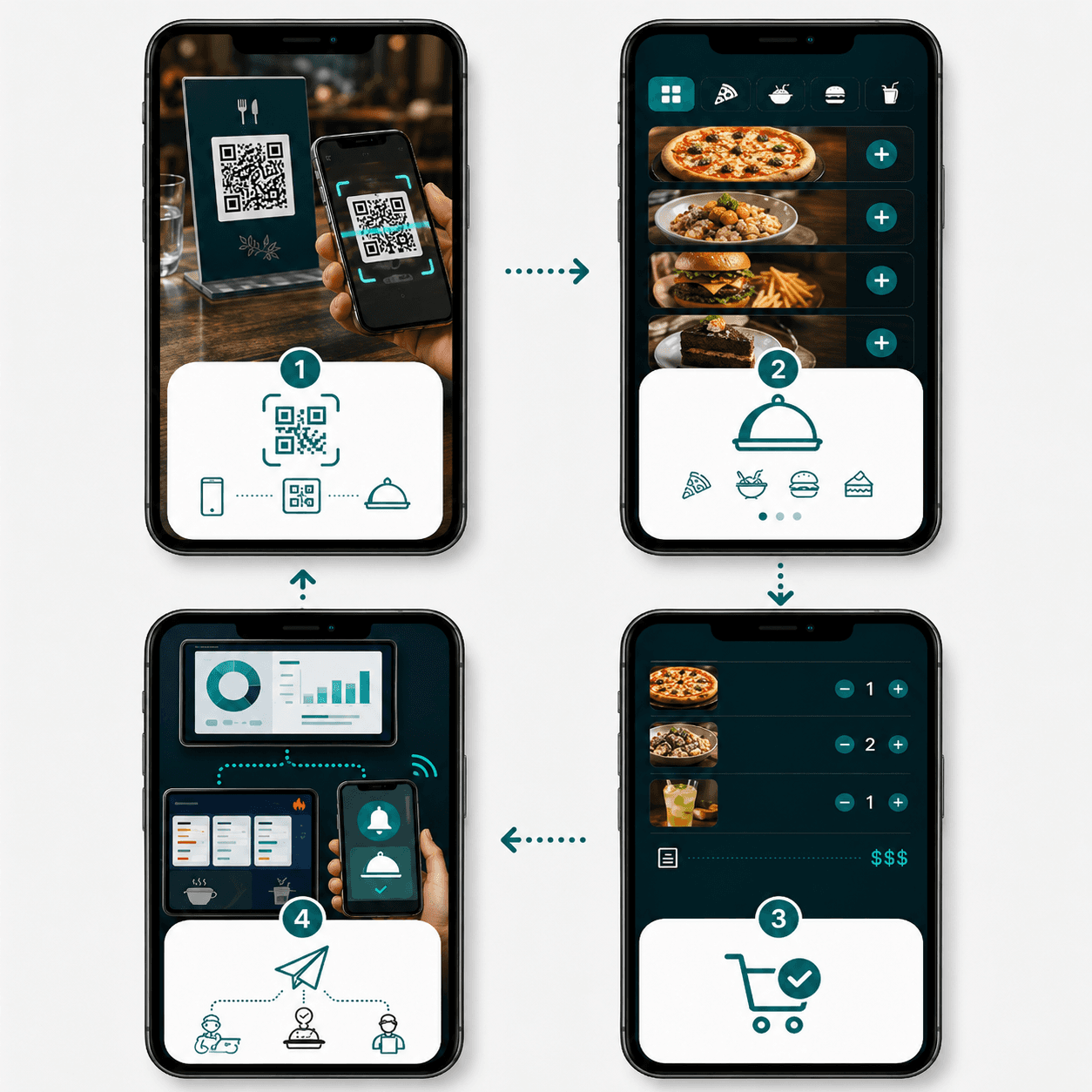
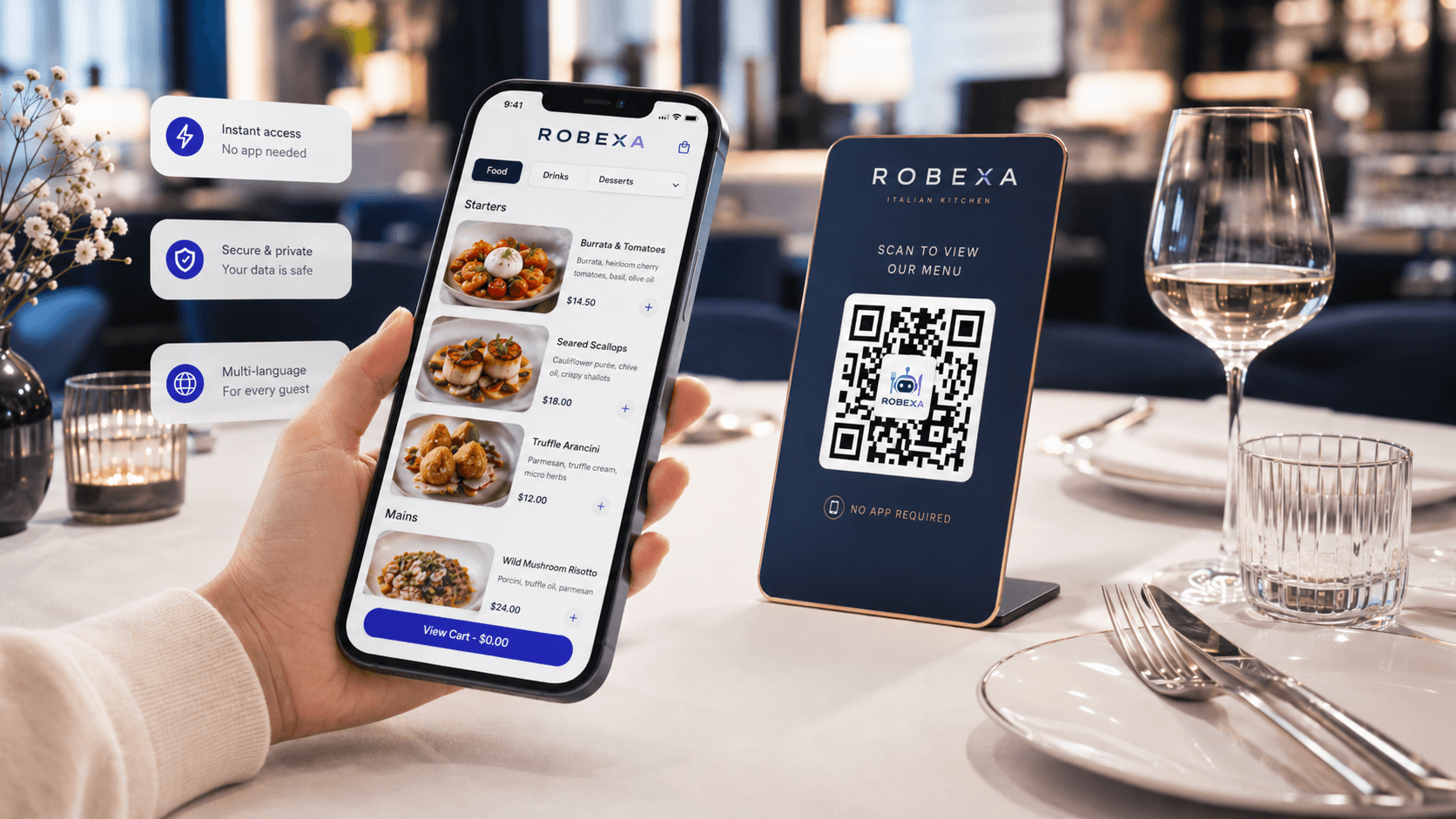
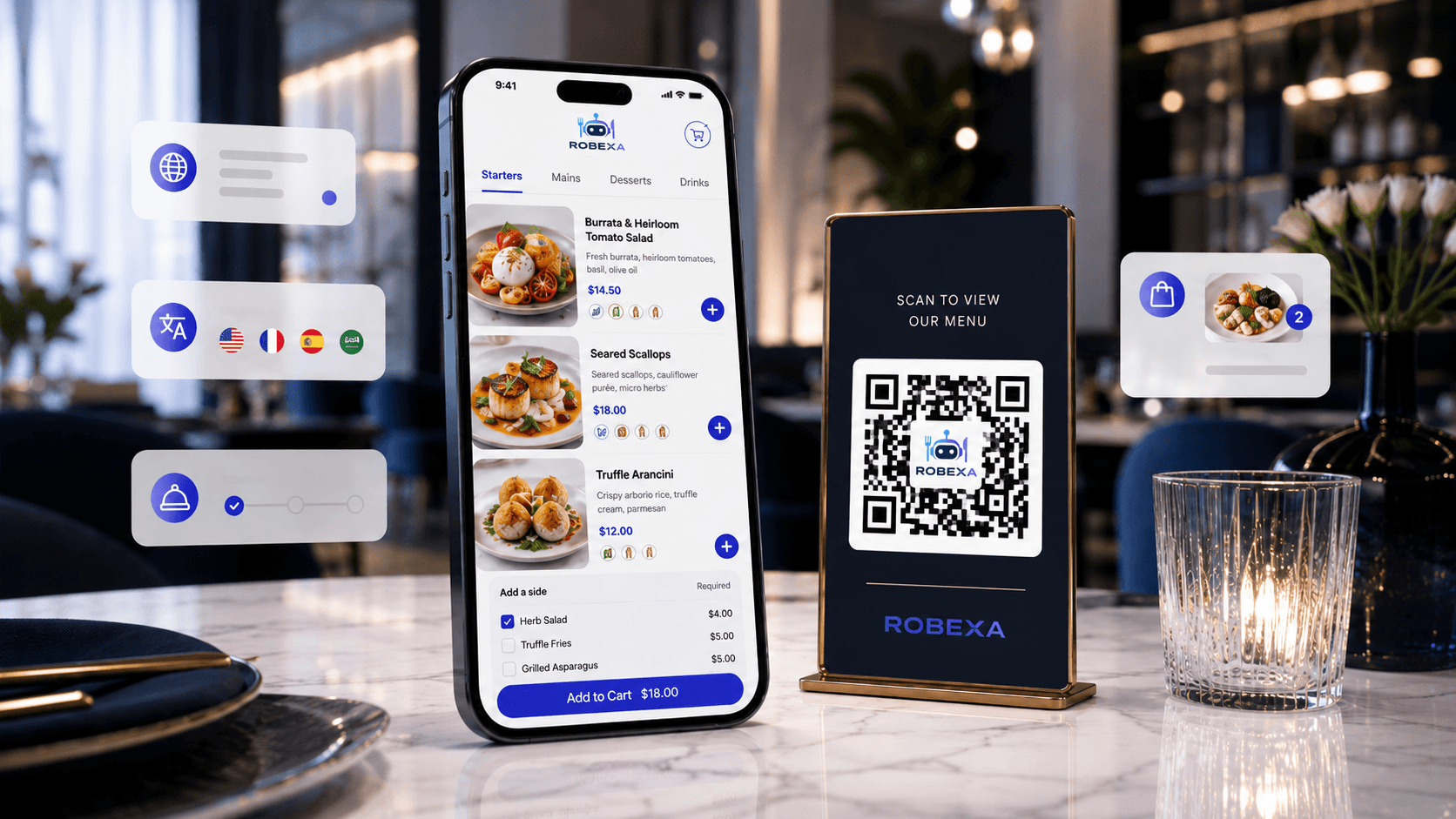
With Robexa table QR ordering, a guest scans the code at the table, opens the digital menu in a browser and submits an order when ordering is enabled.
For standardised orders, this can reduce:
- the initial wait for someone to take the order;
- repeated journeys for drink reorders;
- manual transfer of product, modifier and table;
- some questions about clearly presented choices;
- re-entering an order the guest has already selected.
This does not remove the need for floor staff in a full-service restaurant. Advice, recommendations, allergy conversations, guest care, food running, complaints and assistance remain human responsibilities.
A hybrid model is often the better design:
- guests who want to order independently can use QR;
- guests who need advice or assistance can order with a team member;
- both routes share the same menu and kitchen routing.
Technology then becomes an additional ordering channel rather than an access barrier. See also the guides on handheld systems and efficient digital ordering processes.
3. KDS: fewer paper tickets, shouted updates and kitchen trips
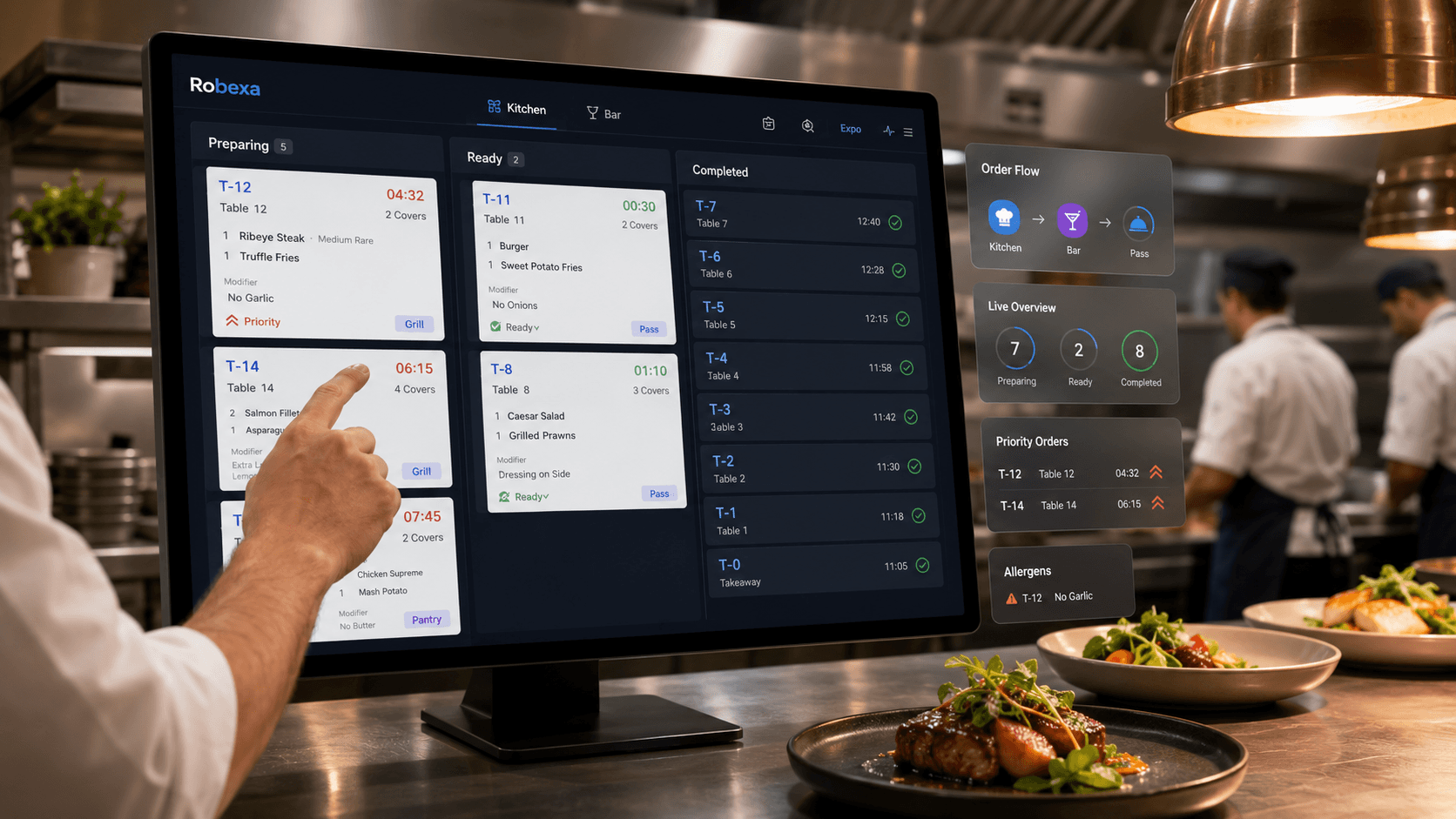
A kitchen display system does not perform kitchen work. It structures the information that kitchen work requires.
Orders from QR, handheld, floor service or online channels can reach the relevant production stations as digital tickets. Kitchen, bar, dessert and pass see the items, modifiers and statuses relevant to them.
This can reduce:
- carrying and sorting paper tickets;
- duplicated or unreadable tickets;
- shouted handovers between kitchen and floor;
- repeated questions about order status;
- unnecessary trips to the pass;
- manual separation of food and drinks across stations.
Multilingual ticket text can also support international teams. DEHOGA figures show that on 30 June 2025, 54.6 percent of socially insured employees in food-led restaurant businesses held a foreign nationality.
Nationality does not indicate any individual employee’s language ability. The figure does, however, show how international many restaurant teams are. Structured modifiers and suitable display languages can make everyday coordination clearer.
4. Self-ordering kiosk: less permanent counter dependency
A self-ordering kiosk is particularly relevant where guests would normally order at a counter:
- quick-service restaurants;
- snack bars and takeaway businesses;
- cafés and bakeries;
- food-court concepts;
- high-volume pickup areas.
Guests select products and options on the display, and the structured order enters the connected operating workflow.
Not every standard order then needs to be fully captured by an employee at the counter. The team can devote more time to handover, product quality, replenishment, cleaning, guest questions or the station that is currently under pressure.
A human alternative remains important. Not every guest wants to or can use a touchscreen. Good self-service design makes help visible and does not force every person through the same channel.
The greatest value appears between modules
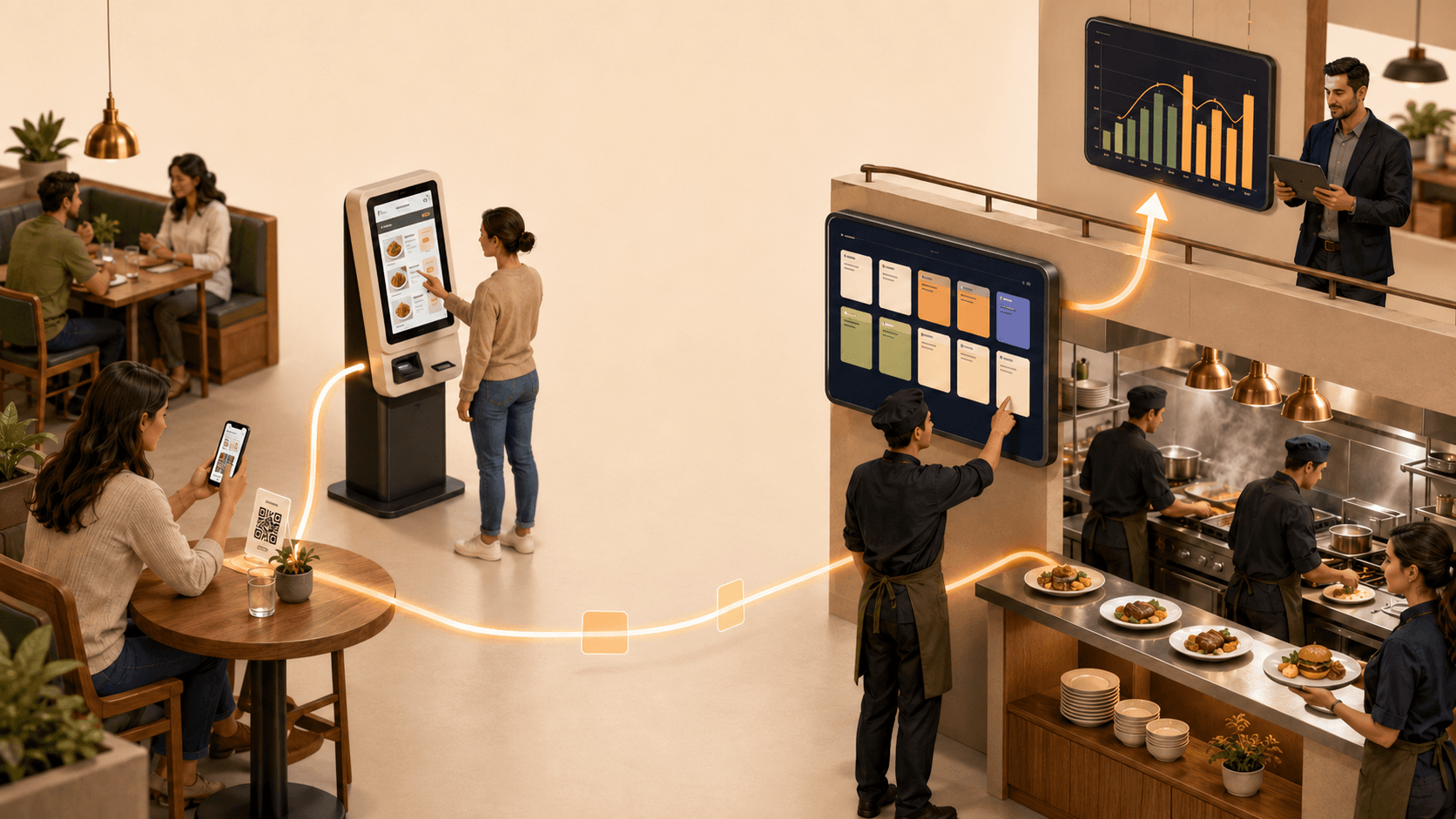
A QR code, kitchen screen and kiosk can each reduce work. If they run as isolated systems, however, they create new handovers:
- different menus;
- inconsistent prices;
- duplicated availability settings;
- separate order numbers;
- unclear ownership;
- additional checking.
The main advantage of a connected restaurant management platform is therefore the shared data and order flow:
- The guest or team member enters the order once.
- Product, modifier, table or pickup context stays with the order.
- Items route to the correct work areas.
- Status remains visible to production, handover and service.
- Revenue and order time become part of management reporting.
Each order is therefore both an operational task and a data point for the next staffing decision.
Time released is not automatically time removed
When a digital order avoids three manual steps, the restaurant initially gains capacity. What happens next depends on the concept.
That time can be used for:
- more personal advice on dishes that require explanation;
- faster handover and table care;
- quality control at the pass;
- preparation for the next rush;
- cleaning and replenishment;
- proactive guest communication when delays occur;
- training new team members;
- a leaner schedule in time windows that data consistently proves are quiet.
Only when several weeks of evidence show that particular paid hours are no longer required can the shift structure be adjusted responsibly.
The honest message is not:
“Robexa replaces a specific number of employees.”
It is:
“Robexa reduces avoidable manual steps and shows when your restaurant genuinely needs each kind of capacity.”
Which combination fits which restaurant?
| Restaurant type | Common constraint | Sensible starting point |
|---|---|---|
| Full-service restaurant | Floor staff move between table, station and kitchen; peaks are uneven | Reporting, handheld or QR as a hybrid model, plus KDS |
| Large terrace or beer garden | Long walking distances and frequent reorders | QR reordering, handheld and clear kitchen routing |
| Quick-service restaurant or snack bar | Counter queue and an employee continuously tied to order entry | Self-ordering kiosk, KDS and hourly demand analysis |
| Café or bakery | Short morning/lunch rush followed by substantially lower traffic | Reporting for shift boundaries and an optional kiosk for standard orders |
| Multi-station restaurant kitchen | Questions, paper tickets and unclear priorities | KDS with station routing and live status |
| Small, advice-led restaurant | Personal service is part of the product | Reporting and handheld, with QR as an option rather than a requirement |
Not every restaurant needs every module. A useful rollout begins with the workflow that currently consumes the most time, walking or corrections.
How restaurants measure the effect instead of guessing
A credible evaluation starts with a baseline. Before making a change, record the figures that match the problem across several comparable weeks.
Financial operating metrics
Labor cost ratio
Labor cost ratio = labor costs / net revenue × 100
Revenue per paid labor hour
Revenue per labor hour = net revenue / paid labor hours
Orders per paid labor hour
Orders per labor hour = number of orders / paid labor hours
These figures should never be read in isolation. Very high apparent productivity can also be evidence of understaffing if waiting times, errors or sickness absence increase.
Workflow and service metrics
- time from order confirmation to kitchen receipt;
- average and maximum KDS ticket time;
- number of questions between floor and kitchen;
- corrected or duplicated orders;
- counter waiting time;
- share of digital and staff-assisted orders;
- complaints about waiting or lack of assistance;
- overtime and unplanned shift extensions;
- team feedback after rush periods.
The comparison that matters
Not: “Did revenue rise after installation?”
Instead:
At comparable demand, did the restaurant operate with fewer manual handovers, less unplanned labor time and equal or better service quality?
A controlled 30-day starting plan
Week 1: make demand and work visible
- Review orders and sales by weekday and hour.
- Compare the schedule with actual hours worked.
- Observe one complete order journey.
- Mark unnecessary walking, double entry and repeated questions.
Week 2: choose one primary constraint
For example:
- drink reorders consume floor capacity;
- the counter is overloaded only during short time windows;
- tickets must be split manually between kitchen and bar;
- floor staff repeatedly walk to the kitchen to ask about progress.
Select only one primary goal for the first pilot.
Week 3: pilot one area or shift
- Enable QR ordering in one section only;
- use the kiosk for one clear standard journey;
- test KDS routing with selected production stations;
- keep an alternative path available for team members and guests.
Week 4: compare data and team feedback
- Review before-and-after measures.
- Record exceptions and problems.
- Correct menu structure, routing, roles or shift boundaries.
- Expand only after the base workflow is stable.
What Robexa does not solve automatically
Software cannot repair an unclear operating model by itself.
Robexa does not automatically solve:
- missing professional skills in kitchen or service;
- an unattractive workplace culture;
- unfair pay or poor schedules;
- a badly costed menu;
- unclear responsibilities;
- unstable Wi-Fi;
- missing accessibility;
- legal requirements for working time, breaks and documentation;
- every fluctuation caused by weather, events or local disruption.
The value appears when technology, roles and real restaurant workflows are designed together.
Frequently asked questions
Can a digital ordering system replace waiters?
It can reduce some pure order-taking tasks, but it cannot replace every floor responsibility. Advice, hospitality, handover, complaints and assistance remain important. In full-service restaurants, a hybrid model is usually more appropriate than digital-only service.
How does hourly revenue help with restaurant staffing?
It reveals recurring rush periods, quiet windows and the real beginning and end of demand. Combined with reservations, events and actual hours worked, it helps management place shift boundaries and reinforcement more deliberately.
Does a KDS reduce restaurant labor costs?
Not automatically. A KDS can reduce paper handling, shouted updates, repeated questions and unnecessary trips. Whether that produces fewer paid hours, more capacity or better service quality must be measured in the restaurant.
Is QR ordering suitable for a traditional restaurant?
Yes, when it is offered as a choice. Guests can submit standard orders or reorders themselves while the floor team remains available for advice and personal hospitality.
Is a self-ordering kiosk only useful in fast food?
Its strongest use case is standardised counter and takeaway ordering. Cafés, bakeries and busy pickup areas can also benefit. In advice-led concepts, its value may be lower or it should remain an optional channel.
How many employees can a restaurant save with Robexa?
A fixed number would be misleading without the restaurant’s own data. Concept, opening hours, menu, volume, service level and existing workflows vary too widely. A measured pilot should compare labor hours, sales, orders, ticket times and service quality before and after the change.
Conclusion: Less idle work, not less hospitality
German restaurants are operating under simultaneous cost, demand and staffing pressure. In NRW, weak real revenue, rising insolvencies and a workforce structure heavily shaped by Minijobs make that pressure especially visible.
The answer is not a blanket staff reduction.
It is more precise work design:
- reporting shows when capacity is required;
- QR ordering reduces repetitive order capture at the table;
- KDS routes orders clearly into kitchen and bar;
- kiosks relieve standardised counter workflows;
- a shared platform keeps menu, order, status and reporting connected.
That allows a lean or hard-to-staff team to work more calmly and place its available time where it creates the greatest value for guests and the business.
Free initial consultation: Where does your team lose time today?
Together, we examine your rush periods, quiet windows, order journeys and handovers between guest, floor, counter and kitchen.
You will not receive a generic recommendation to add as much technology as possible. We identify the workflow where reporting, QR ordering, KDS or a kiosk can provide the most useful first improvement for your restaurant.
Request a free, no-obligation initial consultation
Sources and date
Data and links checked on 24 July 2026.
- Federal Statistical Office: German hospitality revenue in May 2026
- DEHOGA: Industry figures for Q4 2025, dated 24 February 2026
- DEHOGA member survey: Personnel costs as the strongest pressure
- IT.NRW: Revenue development in NRW hospitality, 2016–2025
- IT.NRW: Business insolvencies in 2025
- IT.NRW: Minijobs in NRW hospitality
- Federal Ministry of Labour and Social Affairs: Minimum wage from January 2026
- Minijob-Zentrale: Earnings limit and maximum monthly hours